 Image 1 of 1
The Digital Detox Workbook
You check your phone a hundred times a day. You decided almost none of them.
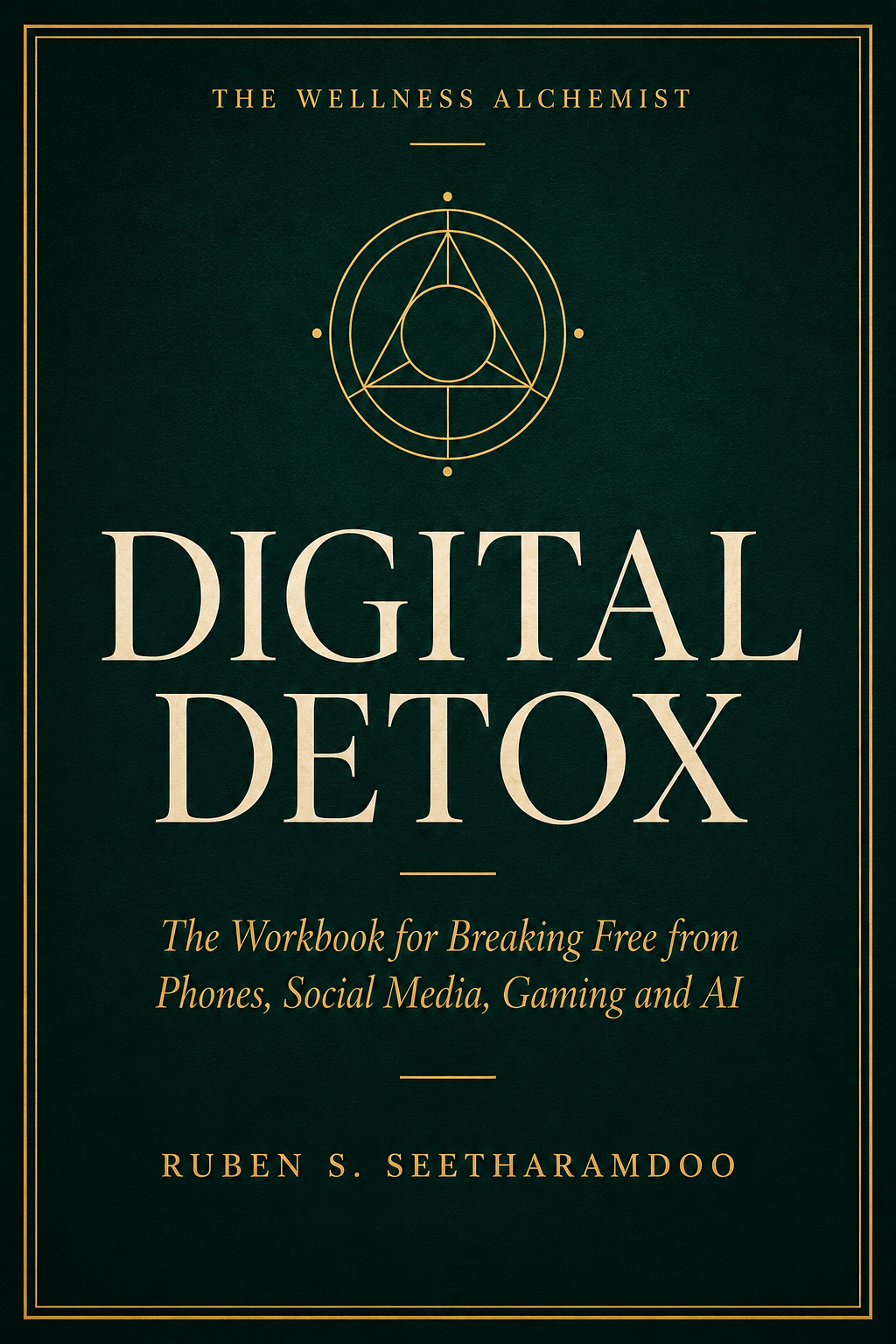
Digital Detox: The Workbook for Breaking Free from Phones, Social Media, Gaming and AI by Ruben S. Seetharamdoo, RMN. A written-in, worked-through programme for getting your attention, your sleep and your evenings back.
Hardcover, 103 pages. £24.99.
I spent thirty years in NHS clinical and managerial roles across addiction services, at Harley Street and at the Priory. If you had asked me in 1995 to name the behaviour doing the most damage to the most people, I would have said alcohol without hesitation. Ask me today and I will tell you plainly: it is compulsive digital use. The endless check, the feed that eats an evening, the game that eats a weekend, and now the AI conversation that has quietly become a relationship.
This is not a book about phones. It is a workbook about the mechanism underneath, the same one I treated for three decades, and it asks you to write in it. In pen. Because the person who fills in a worksheet honestly learns something the person who reads a chapter and nods does not.
What is actually inside
A self-screener before anything else. You start by measuring the pattern, with an original screener built on the same ground as the validated instruments, alongside the numbers your own devices already record. No guessing about whether you have a problem or how big it is.
Eleven chapters, eighteen worksheets. The early chapters map the habit and reset its triggers: the anchor underneath the urge, the belief that keeps it in place, the need it has been meeting since long before smartphones existed. The middle of the book brings in the body, sleep, posture and eye strain included, then motivational interviewing for the part of you that does not want to change, and cognitive behavioural therapy for the thought that arrives just before you unlock the screen.
Four methods you will use for the rest of your life. The Alchemist Outcome Method turns a vague wish into one stated, testable outcome. The Elixir Method resets a craving in the moment it appears. The Mirror Method works with ambivalence, yours or someone you love. The Reframe Method takes apart the thought that justifies one more scroll.
A 21-day detox plan, differentiated by your score. Not a blanket digital blackout. Blackouts are the version of a detox most likely to fail, and the research says so. Your plan is built to your screener band, from a single tested boundary up to a full structured programme with a daily tracker.
The traditions that were working before apps existed. The Twelve Steps, adapted honestly for digital compulsion. Ten techniques drawn from ten of the most respected contemporary books on addiction, credited to where they came from. And a closing chapter of spiritual practice from Ayurvedic, Hindu, Buddhist and yogic teachers, for the reader who suspects the missing piece was never purely psychological.
Chandramani. The teacher whose stories open every chapter, returning each time to the same plain truth: a pattern learned can be unlearned, though rarely by arguing with it directly.
Who it is for
The professional whose evenings vanish into a feed. The gamer whose sessions stopped being a choice some time ago. The parent who cannot ask for the phone to be put down without hearing the obvious reply. The person whose most honest conversation of the day is with a chatbot. Wherever this book says "the behaviour," you read it as yours. The mechanism is identical, and every worksheet is built to be filled in with your specific answer, not a generic one.
It stands alone. You do not need the original 5½ Ways to Well-Being or any other volume to use it.
One honest boundary: a workbook is not treatment. If your pattern involves harm to yourself, or a low mood that will not lift, the right next step is a GP or a therapist, and the book says so in plain terms at the points where it matters.
About the author
Ruben S. Seetharamdoo is a Senior Lecturer at the University of West London, a Registered Mental Health Nurse and a Fellow of the Royal Society of Public Health. Every claim in the workbook is cited: the evidence base runs from the World Health Organization's recognition of gaming disorder to the 2025 randomised trial showing what three weeks of reduced screen time did to mood, sleep and stress. The full bibliography is in the back, in APA style, because a book asking for your trust should show its working.
Short FAQ
Is this just another screen-time advice book? No. It is a workbook: eighteen worksheets, a screener you take twice, and a 21-day tracker. You will spend more time writing than reading.
Do I need to quit my phone? No. You will target the one or two behaviours doing the most damage. A realistic, specific detox consistently outperforms quitting everything at once, and the book cites the evidence for that.
I have read the addiction classics already. Then you will recognise the ten authors whose techniques appear in Chapter Eight, each credited and turned into something you can do this week.
Does it work for gaming and AI chatbots, not just social media? Yes. The mechanism the book works on is the same across all of them, and it was written with all four in the title for a reason.
You check your phone a hundred times a day. You decided almost none of them.
Digital Detox: The Workbook for Breaking Free from Phones, Social Media, Gaming and AI by Ruben S. Seetharamdoo, RMN. A written-in, worked-through programme for getting your attention, your sleep and your evenings back.
Hardcover, 103 pages. £24.99.
I spent thirty years in NHS clinical and managerial roles across addiction services, at Harley Street and at the Priory. If you had asked me in 1995 to name the behaviour doing the most damage to the most people, I would have said alcohol without hesitation. Ask me today and I will tell you plainly: it is compulsive digital use. The endless check, the feed that eats an evening, the game that eats a weekend, and now the AI conversation that has quietly become a relationship.
This is not a book about phones. It is a workbook about the mechanism underneath, the same one I treated for three decades, and it asks you to write in it. In pen. Because the person who fills in a worksheet honestly learns something the person who reads a chapter and nods does not.
What is actually inside
A self-screener before anything else. You start by measuring the pattern, with an original screener built on the same ground as the validated instruments, alongside the numbers your own devices already record. No guessing about whether you have a problem or how big it is.
Eleven chapters, eighteen worksheets. The early chapters map the habit and reset its triggers: the anchor underneath the urge, the belief that keeps it in place, the need it has been meeting since long before smartphones existed. The middle of the book brings in the body, sleep, posture and eye strain included, then motivational interviewing for the part of you that does not want to change, and cognitive behavioural therapy for the thought that arrives just before you unlock the screen.
Four methods you will use for the rest of your life. The Alchemist Outcome Method turns a vague wish into one stated, testable outcome. The Elixir Method resets a craving in the moment it appears. The Mirror Method works with ambivalence, yours or someone you love. The Reframe Method takes apart the thought that justifies one more scroll.
A 21-day detox plan, differentiated by your score. Not a blanket digital blackout. Blackouts are the version of a detox most likely to fail, and the research says so. Your plan is built to your screener band, from a single tested boundary up to a full structured programme with a daily tracker.
The traditions that were working before apps existed. The Twelve Steps, adapted honestly for digital compulsion. Ten techniques drawn from ten of the most respected contemporary books on addiction, credited to where they came from. And a closing chapter of spiritual practice from Ayurvedic, Hindu, Buddhist and yogic teachers, for the reader who suspects the missing piece was never purely psychological.
Chandramani. The teacher whose stories open every chapter, returning each time to the same plain truth: a pattern learned can be unlearned, though rarely by arguing with it directly.
Who it is for
The professional whose evenings vanish into a feed. The gamer whose sessions stopped being a choice some time ago. The parent who cannot ask for the phone to be put down without hearing the obvious reply. The person whose most honest conversation of the day is with a chatbot. Wherever this book says "the behaviour," you read it as yours. The mechanism is identical, and every worksheet is built to be filled in with your specific answer, not a generic one.
It stands alone. You do not need the original 5½ Ways to Well-Being or any other volume to use it.
One honest boundary: a workbook is not treatment. If your pattern involves harm to yourself, or a low mood that will not lift, the right next step is a GP or a therapist, and the book says so in plain terms at the points where it matters.
About the author
Ruben S. Seetharamdoo is a Senior Lecturer at the University of West London, a Registered Mental Health Nurse and a Fellow of the Royal Society of Public Health. Every claim in the workbook is cited: the evidence base runs from the World Health Organization's recognition of gaming disorder to the 2025 randomised trial showing what three weeks of reduced screen time did to mood, sleep and stress. The full bibliography is in the back, in APA style, because a book asking for your trust should show its working.
Short FAQ
Is this just another screen-time advice book? No. It is a workbook: eighteen worksheets, a screener you take twice, and a 21-day tracker. You will spend more time writing than reading.
Do I need to quit my phone? No. You will target the one or two behaviours doing the most damage. A realistic, specific detox consistently outperforms quitting everything at once, and the book cites the evidence for that.
I have read the addiction classics already. Then you will recognise the ten authors whose techniques appear in Chapter Eight, each credited and turned into something you can do this week.
Does it work for gaming and AI chatbots, not just social media? Yes. The mechanism the book works on is the same across all of them, and it was written with all four in the title for a reason.