 Image 1 of 1
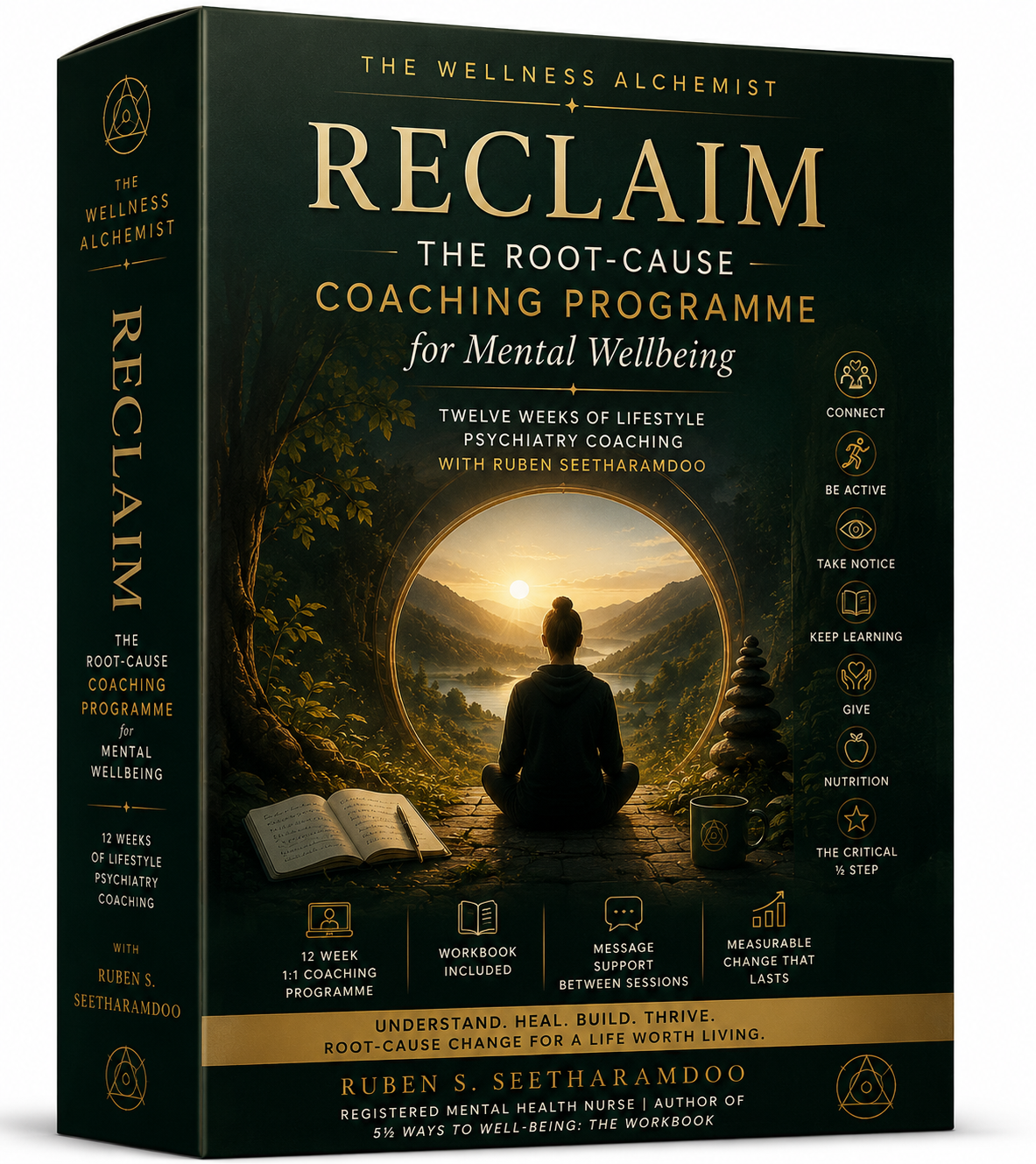
RECLAIM : The Root-Cause Coaching Programme for Mental Wellbeing
Reclaim: The Root-Cause Coaching Programme for Mental Wellbeing
Twelve Weeks of Lifestyle Psychiatry Coaching with Ruben Seetharamdoo
What This Might Actually Feel Like
In Your Body
A tightness in your chest that doesn't have a clear cause. Waking exhausted no matter how much you slept, or not sleeping properly at all, mind running the moment your head hits the pillow. A low hum of tension in your shoulders and jaw that's been there so long you've stopped registering it as tension. Appetite that's either vanished or become the only thing that feels manageable.
In Your Mind
A worry that doesn't have an off switch, quietly running in the background of everything else you're trying to do. Thoughts that loop, replaying conversations, rehearsing worst cases, well past the point of being useful. A fog that makes concentrating at work feel like wading through water. An inner voice that's harsher with you than you'd ever let anyone else be.
In Your Days
Things that used to bring you something, a hobby, a meal out, time with people you love, now feel flat, or like effort you can't quite justify. Getting through a to-do list has replaced actually living most days. You cancel plans more than you used to. You've started saying “I'm fine” so automatically it barely registers as a lie anymore.
In Your Relationships
Feeling present in the room but somewhere else entirely. Snapping at people who don't deserve it, then feeling worse for it. A creeping sense that you're a burden, or that no one would really notice if you pulled back further. Isolating in small, hard-to-name ways: the message you don't reply to, the invitation you decline before you've even really considered it.
If any of this is landing, you are not broken, and you are not alone in it. These experiences are common, they are real, and for many people they are deeply connected to the upstream, modifiable factors this programme addresses, not because willpower was missing, but because no one ever built the structure that makes change actually hold.
A direct word on safety: if what you're reading here feels urgent, more than difficult, or you are having thoughts of harming yourself, please contact your GP, NHS 111, or the Samaritans on 116 123 first. This programme is not crisis support and is not a substitute for clinical care. Coaching sits alongside good clinical treatment, never in place of it, and part of my job is helping you find the right care first if that's what's actually needed.
Programme Structure
Reclaim runs across three months, twelve weekly sessions, built around the five ways to wellbeing and the two methods in my book, 5½ Ways to Well-Being: The Workbook.
Month One — Naming What's Real
Week 1: Full intake, your history, your Well-Being Check-In baseline
Weeks 2–4: Connect, Be Active, Take Notice, one at a time, worked into your actual week, not a generic plan
Month Two — Building What Holds
Weeks 5–7: Keep Learning, Give, Nutrition
Week 8: The Critical ½ Step, why motivation fades, and what replaces it when it does
Month Three — Making It Last
Weeks 9–10: Review every outcome you've built, strengthen what's stalled
Weeks 11–12: A maintenance plan for after we stop meeting, final Well-Being Check-In, honest comparison against week one
Format
12 × 50-minute one-to-one sessions, weekly. Your own copy of the workbook included. Message support between sessions, replies within 48 hours on weekdays.
Ruben takes a limited number of clients at a time, alongside his academic and clinical work.
A Few Honest Questions People Ask
Is this therapy?
No. I'm not delivering psychotherapy, and this isn't a substitute for it. If therapy is what you need, I'll say so, and help you find it.
What if I'm already on medication or in therapy?
Then this can sit alongside that care, addressing the lifestyle factors your other treatment may not have room to cover. I'll ask about your current care during intake.
How do I know if this is right for me, versus needing clinical help first?
If what you're experiencing is manageable but stuck, this is likely a good fit. If it's acute, unsafe, or you're not managing day to day, clinical care comes first, and that's a conversation we can have honestly before we begin.
Reclaim: The Root-Cause Coaching Programme for Mental Wellbeing
Twelve Weeks of Lifestyle Psychiatry Coaching with Ruben Seetharamdoo
What This Might Actually Feel Like
In Your Body
A tightness in your chest that doesn't have a clear cause. Waking exhausted no matter how much you slept, or not sleeping properly at all, mind running the moment your head hits the pillow. A low hum of tension in your shoulders and jaw that's been there so long you've stopped registering it as tension. Appetite that's either vanished or become the only thing that feels manageable.
In Your Mind
A worry that doesn't have an off switch, quietly running in the background of everything else you're trying to do. Thoughts that loop, replaying conversations, rehearsing worst cases, well past the point of being useful. A fog that makes concentrating at work feel like wading through water. An inner voice that's harsher with you than you'd ever let anyone else be.
In Your Days
Things that used to bring you something, a hobby, a meal out, time with people you love, now feel flat, or like effort you can't quite justify. Getting through a to-do list has replaced actually living most days. You cancel plans more than you used to. You've started saying “I'm fine” so automatically it barely registers as a lie anymore.
In Your Relationships
Feeling present in the room but somewhere else entirely. Snapping at people who don't deserve it, then feeling worse for it. A creeping sense that you're a burden, or that no one would really notice if you pulled back further. Isolating in small, hard-to-name ways: the message you don't reply to, the invitation you decline before you've even really considered it.
If any of this is landing, you are not broken, and you are not alone in it. These experiences are common, they are real, and for many people they are deeply connected to the upstream, modifiable factors this programme addresses, not because willpower was missing, but because no one ever built the structure that makes change actually hold.
A direct word on safety: if what you're reading here feels urgent, more than difficult, or you are having thoughts of harming yourself, please contact your GP, NHS 111, or the Samaritans on 116 123 first. This programme is not crisis support and is not a substitute for clinical care. Coaching sits alongside good clinical treatment, never in place of it, and part of my job is helping you find the right care first if that's what's actually needed.
Programme Structure
Reclaim runs across three months, twelve weekly sessions, built around the five ways to wellbeing and the two methods in my book, 5½ Ways to Well-Being: The Workbook.
Month One — Naming What's Real
Week 1: Full intake, your history, your Well-Being Check-In baseline
Weeks 2–4: Connect, Be Active, Take Notice, one at a time, worked into your actual week, not a generic plan
Month Two — Building What Holds
Weeks 5–7: Keep Learning, Give, Nutrition
Week 8: The Critical ½ Step, why motivation fades, and what replaces it when it does
Month Three — Making It Last
Weeks 9–10: Review every outcome you've built, strengthen what's stalled
Weeks 11–12: A maintenance plan for after we stop meeting, final Well-Being Check-In, honest comparison against week one
Format
12 × 50-minute one-to-one sessions, weekly. Your own copy of the workbook included. Message support between sessions, replies within 48 hours on weekdays.
Ruben takes a limited number of clients at a time, alongside his academic and clinical work.
A Few Honest Questions People Ask
Is this therapy?
No. I'm not delivering psychotherapy, and this isn't a substitute for it. If therapy is what you need, I'll say so, and help you find it.
What if I'm already on medication or in therapy?
Then this can sit alongside that care, addressing the lifestyle factors your other treatment may not have room to cover. I'll ask about your current care during intake.
How do I know if this is right for me, versus needing clinical help first?
If what you're experiencing is manageable but stuck, this is likely a good fit. If it's acute, unsafe, or you're not managing day to day, clinical care comes first, and that's a conversation we can have honestly before we begin.